


Fund fuels new opportunities for physician-scientists at Duke
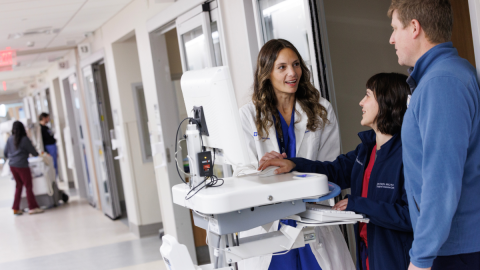
When Mara Serbanescu, MD, arrived at Duke as a junior faculty member, she found an environment deeply focused on physician-scientist development.
That experience shaped the dual roles that are now defining her career — caring for critically ill patients while researching why some experience more complications than others in the intensive care unit.
Physicians who also conduct research are uniquely positioned to advance human health. However, this career pathway requires significant training and funding, and physician-scientists have long been vulnerable to attrition.
A new $11.45 million award from The Fund Established by Will of Nanaline H. Duke expands the ability of early-career physician-scientists like Serbanescu to develop and innovate. The award will accelerate groundbreaking research that transforms patient care, while strengthening Duke’s role as a national leader in physician-scientist development, said Duke University President Vincent E. Price.
“Investing in physician-scientists early in their careers is essential to driving medical innovation,” Price said. “We are delighted that the fund has deepened its partnership with Duke, reflecting our shared vision for bridging discovery and patient care. Together, we are building the foundation for breakthroughs that will improve lives worldwide.”
The gift builds on previous support and provides backing for five more years, underscoring the remarkable success of physician-scientist development at Duke. Through the Office of Physician Scientist Development (OPSD), Duke provides comprehensive support to ensure that early-career faculty can thrive. For the past decade, the centerpiece of this strategy has been the Strong Start Award Program.
To date, Strong Start has supported 46 physician-scientists from 10 departments with annual research support for three years. The vast majority have remained at Duke, and together they have secured more than 135 federal and private awards, contributing to critical medical advancements.
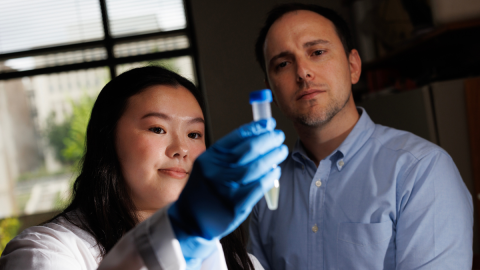
Serbanescu received a Strong Start Award in 2024, which launched her independent research program studying how gut bacteria impact the immune system and clinical outcomes in critically ill patients. The funding provided resources to collect samples from ICU patients so she could begin answering her own questions: Are genetic fingerprints from bacteria that normally live in the gut present in the blood after major surgery? If so, do they influence a patient’s recovery? She then landed a highly competitive federal grant to broaden her research.
“Support for the next generation of physician-scientists is embedded throughout the culture at Duke, and it’s what has impressed me most since arriving three years ago,” said Serbanescu, assistant professor in anesthesiology, who came to Duke from Johns Hopkins. “No other award has accelerated the growth of my lab and the trajectory of my research career as much as the Strong Start.”
The new gift will extend Strong Start and expand additional support for physician-scientists with Bridge Funding and New Directions awards through the Health Innovation Fund.
“Duke Health has long-recognized the critical contributions of physician-scientists in connecting clinical practice and scientific discovery, and we are profoundly grateful to the Nanaline H. Duke fund for supporting this lifesaving work,” said Mary E. Klotman, MD, executive vice president for health affairs of Duke University, dean of Duke University School of Medicine, and chief academic officer of Duke Health. “Drawing on their rigorous training in medicine as well as research, these unique individuals help bridge these two worlds to better understand disease, then use their findings to improve prevention, diagnoses, and treatment.”
Although critical to advancing human health, physician-scientists represent only 1.5% of the biomedical workforce, compared with 4.7% 40 years ago.
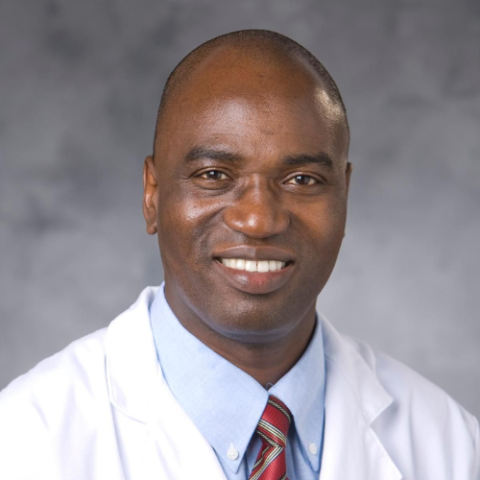
Duke’s OPSD, which Klotman established in 2018, is working to reverse that trend.
“The national decline in physician-scientists poses a significant threat to medical innovation,” said OPSD Director Rasheed Gbadegesin, MD, MBBS. “Together, Duke and the Nanaline H. Duke fund have made the bold commitment to invest in early-stage investigators and nurture their success by providing training, mentoring, funding, and leadership development.”
The investment is paying off. One Strong Start scholar is pioneering new approaches in cancer immunotherapy, harnessing the body's own defenses to fight cancer more effectively. Another scholar is exploring new ways to slow the progression of Alzheimer’s disease. Still others are working on innovative treatments to help patients with heart conditions.
Jeffrey Russ, MD, PhD, credits Duke with providing not only monetary support through Strong Start but also a community for physician-scientists. A pediatric neurologist who studies developmental disorders in babies and cares for newborns with brain injury, Russ chose Duke for its emphasis on early-career support.
“Coming out of more than a decade of training is one of the most vulnerable, precarious times,” said Russ, assistant professor of pediatric neurology, who came to Duke from UCSF Medical Center. “Duke really cultivates the interface between science and the clinic. My lab and research independence are largely due to OPSD and Strong Start.”
The Fund Established by Will of Nanaline H. Duke, named after the wife of James B. Duke, supports Duke University Hospital, the School of Medicine, and medical research at Duke and has contributed to a wide variety of programs at Duke University since Nanaline Duke’s death in 1962. The fund is governed by trustees of The Duke Endowment.
Eamon Queeney is assistant director of creative and multimedia services in the Office of Strategic Communications at the Duke University School of Medicine.