


Visionary gift propels Duke Eye Center to forefront of ocular immunology
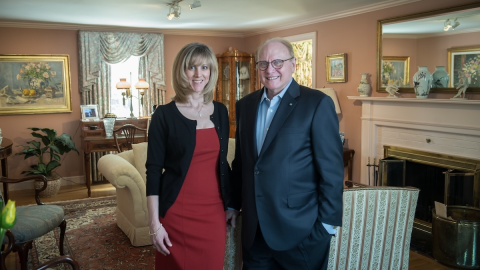
Seven years after opening, the Frances and Stephen Foster Center for Ocular Immunology at Duke Eye Center has made great strides in advancing the evaluation, diagnosis, treatment, and research of inflammatory eye diseases.
C. Stephen Foster, MD, and his wife, Frances Foster, visionary philanthropic partners, launched the first university-based center dedicated to clinical care and cutting-edge research aimed at uncovering the mechanisms of inflammation affecting the eye and developing effective treatments. Longtime supporters of Duke Eye Center, the Fosters understand the importance of bringing together researchers and clinicians to find new ways to save and restore sight.
“I am profoundly grateful for Stephen and Frances Foster’s extraordinary vision and generosity,” said Edward G. Buckley, MD, chair of Duke Ophthalmology. “Their commitment has propelled Duke Eye Center to the forefront of ocular immunology — strengthening our ability to deliver world-class care for patients with the most challenging inflammatory eye diseases, fueling pioneering research, and preparing the next generation of leaders in this vital field.”
In a full-circle moment, Esen K. Akpek, MD, has been named director of the Foster Center. A global authority in corneal and stem cell transplantation and ocular surface reconstruction, Akpek, president of the Foster Ocular Immunology Society, trained with Dr. Foster. She succeeds Victor L. Perez, MD, the center’s inaugural director, and divides her time between patient care and research ranging from artificial cornea development to Sjogren's disease, a severely underdiagnosed autoimmune condition that affects glands producing moisture.
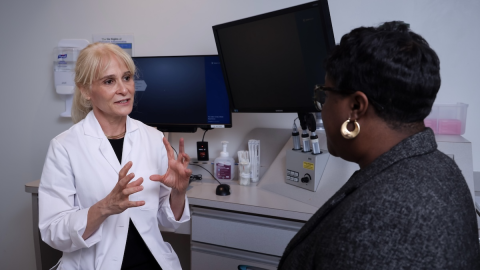
“Dr. Foster is a giant in the field of ocular immunology, or inflammatory diseases of the eye, and I was incredibly fortunate to train with him daily for three years,” said Akpek, professor of ophthalmology and chief of the new Division of Ocular Immunology. “I’m thrilled to lead the center that he and Frances created at Duke, where their gifts have had profound impact, helping to better serve patients with serious vision problems and funding groundbreaking research.”
Since 2018, the Foster Center has cared for more than 11,900 unique patients and 43,500 visits and has created clinics in pediatric rheumatology and adult uveitis and rheumatology. Duke became one of only four centers nationwide to offer Plasma Rich in Growth Factors eye drops, which are made from a patient’s own blood to treat ocular surface diseases. Used for advanced healing needs like wound repair and tissue regeneration, the drops are also effective for dry eye.
When the Fosters first sought to establish a philanthropic partnership with an academic medical center, they considered several elite institutions. Ultimately, they chose Duke.
“We found the environment at Duke to be very collaborative, and we felt this was where we wanted to be involved,” said Dr. Foster, who earned undergraduate and medical degrees at Duke. “The center is evolving with Dr. Akpek as director, and I could not be more pleased. My heart’s about to burst.”
They created the Stephen and Frances Foster Lecture in 2010, then endowed the Stephen and Frances Foster Professorship six years later. To implement the broader vision they share with Duke Ophthalmology, they created the Foster Center and established an endowment to support the center’s work in perpetuity, also including philanthropic plans in their estate to further support the center’s missions in research, patient care, and education.
“Duke has been a wonderful partner,” said Frances Foster, a nurse practitioner and consultant at Massachusetts Eye Research and Surgery Institution (MERSI), which Dr. Foster founded. “We created the Foster Center to treat inflammation from the front to the back of the eye, while advancing research from the bench to practice.”
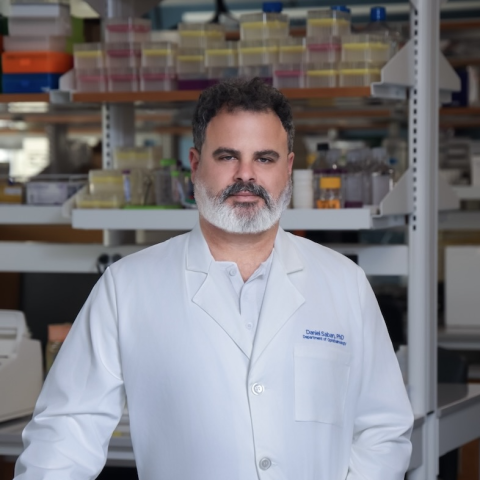
Daniel Saban, PhD, the Foster Center’s scientific director, credits the unique collaboration between scientists and physicians with advancing his research. Saban studies how inflammation of the tissues surrounding the eye contributes to Meibomian gland dysfunction, a disorder of oil glands in the eyelid and the leading cause of dry eye disease. His research will lay the groundwork for the development of new drug targets.
“A researcher can spend years uncovering cell pathways and inflammatory cascades and receptors, but without engaging with clinicians to understand disease progression in patients, it is very challenging to produce translational impact,” said Saban, the Joseph A.C. Wadsworth Distinguished Professor of Ophthalmology. “The center makes this possible.”
With ongoing philanthropic support, groundbreaking research initiatives, and Akpek’s vision, the Foster Center, a recognized leader in ocular inflammatory diseases, can reach new heights.
“I am thrilled that Dr. Akpek will guide the next chapter,” Buckley said. “Her leadership will honor the Fosters’ unwavering dedication to advancing vision health worldwide and ensure that the center’s impact resonates for decades to come.”
Campus photography by HuthPhoto